English
 Français
 Deutsch
 Español
 Italiano
 Português
What is CCaaS?
A cloud-native approach to contact center operations
CCaaS, or Contact Center as a Service, refers to a cloud-based software that delivers all essential contact center capabilities through a subscription-based platform. Instead of relying on physical infrastructure hosted on-site, organizations access telephony, routing, reporting, and channel management through the cloud. This architecture removes many of the technical constraints traditionally associated with contact centers, allowing teams to deploy, scale, and operate their environments with far greater flexibility.
Because the platform is cloud-native, agents and supervisors can work from virtually any location as long as they have a internet connection while accessing the same tools and data in real time. This has become especially important as remote and hybrid work models continue to redefine contact center operations.
Moving beyond legacy contact center systems
Traditional contact center solutions were often designed around fixed capacity, proprietary hardware, and long upgrade cycles. Expanding to new channels, adding users, or introducing new features typically required significant investment and long implementation timelines. These limitations made it difficult for organizations to respond quickly to changing customer expectations or sudden shifts in call volumes.
CCaaS removes these barriers by separating contact center functionality from physical infrastructure. Capacity can be adjusted dynamically, new features are rolled out continuously, and integrations can be activated without complex development projects. This shift fundamentally changes how contact centers evolve over time.
CCaaS as a long-term operating model
Rather than being viewed as a simple technology replacement, CCaaS should be understood as an operating model for customer engagement. It enables organizations to design processes that are adaptable by default, supported by real-time data and continuous optimization. In this sense, CCaaS becomes a strategic asset that supports both operational efficiency and long-term customer experience goals.
The key features of CCaaS

Unified omnichannel interaction management
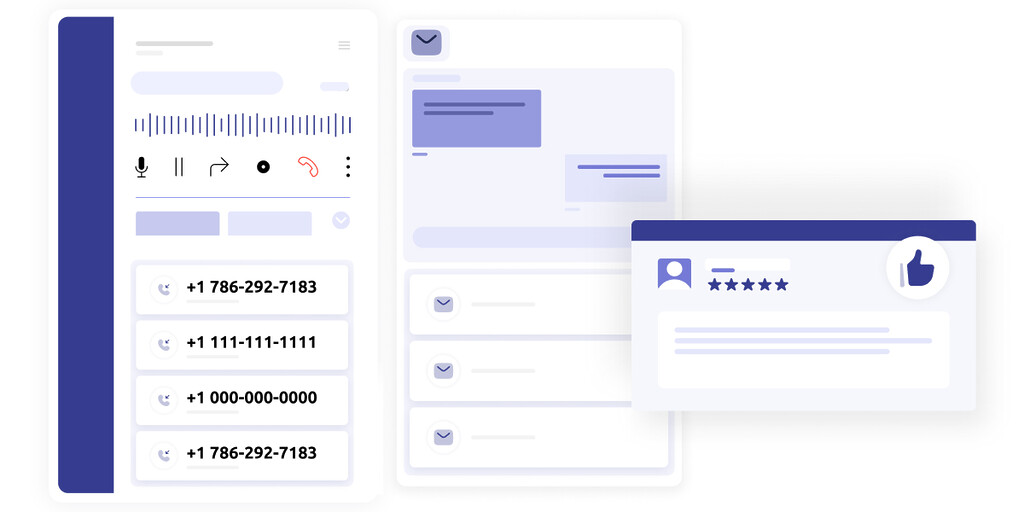
A defining feature of CCaaS is its ability to manage multiple communication channels within a single, unified platform. Voice, email, live chat, messaging applications, and social channels are handled through the same environment, ensuring consistency across customer interactions. This omnochannel approach prevents silos between channels and enables smoother customer journeys, regardless of how or when customers choose to engage.
From an operational perspective, omnichannel management also simplifies training and supervision. Agents work within a single interface, while managers gain a consolidated view of performance and workload across all channels.
Advanced routing and distribution logic with CCaaS
CCaaS platforms rely on intelligent routing mechanisms to connect customers with the most appropriate agent or resource. Routing decisions can be based on skills, language, availability, customer history, or priority level. This level of control helps reduce unnecessary transfers and improves first-contact resolution.
Over time, routing strategies can be refined using performance data and customer feedback. This allows contact centers to continuously improve efficiency while maintaining service quality, even as volumes fluctuate.
Deep integrations with CRM and enterprise systems
Modern CCaaS solutions are built to integrate natively with CRM platforms and other enterprise applications. These integrations ensure that customer data, interaction history, and case context are available at the moment of the interaction. Agents no longer need to switch between systems or manually enter information during or after a call.
This tight integration improves data accuracy, reduces handling time, and enables more personalized conversations. It also allows organizations to align their contact center operations more closely with sales, support, and customer success teams.
Comprehensive analytics and performance visibility
CCaaS provides real-time and historical analytics that give managers deep visibility into contact center performance. Service levels, wait times, agent activity, and customer outcomes can be monitored continuously. Beyond standard KPIs, advanced reporting allows organizations to identify trends, recurring issues, and operational bottlenecks.
These insights are essential for informed decision-making. They support workforce planning, process optimization, and targeted coaching initiatives that drive measurable performance improvements.
How CCaaS can integrate artificial intelligence
AI as an enabler of agent efficiency
Artificial intelligence is increasingly embedded within CCaaS platforms to support agents during live interactions. AI-powered assistance can surface relevant customer information, suggest responses, and generate real-time summaries. By automating repetitive tasks such as note-taking or data entry, AI reduces cognitive load and allows agents to focus on active listening and problem resolution.
This form of augmentation does not replace agents but enhances their ability to handle complex interactions effectively and consistently.
Intelligent automation of customer interactions
CCaaS platforms also leverage AI to automate high-volume, low-complexity interactions. Virtual agents and conversational interfaces can handle routine requests around the clock, providing immediate responses without human intervention. These automated interactions are integrated into the broader contact center workflow, ensuring smooth handoffs to human agents when needed.
This approach improves responsiveness while optimizing resource allocation, especially during peak periods.
Turning interaction data into actionable insights
AI-driven analytics play a growing role in helping organizations extract value from large volumes of interaction data. Technologies such as speech analytics and satisfaction analysis enable contact centers to understand customer intent and recurring pain points at scale.
These insights support proactive improvements in processes, scripts, and training, transforming the contact center into a source of strategic intelligence rather than a purely operational function.
The main advantages of CCaaS for contact centers
Elastic scalability and business continuity
One of the most tangible benefits of CCaaS is its ability to scale elastically. Contact centers can add or reduce capacity quickly in response to demand without investing in additional infrastructure. This is particularly important for organizations that experience seasonal spikes, promotional surges, or unexpected events.
Cloud-based redundancy and resilience also enhance business continuity, ensuring consistent service availability even in disruptive situations.
Faster adaptation to changing customer expectations
Because CCaaS platforms evolve continuously, organizations benefit from ongoing innovation without disruptive upgrade projects. New channels, features, and capabilities can be adopted incrementally, allowing contact centers to keep pace with changing customer behaviors.
This agility is critical in competitive markets where customer experience is a key differentiator.
Improved working conditions for agents
CCaaS environments are designed to simplify agent workflows. Unified tools, automation, and better access to information reduce friction in daily tasks. This has a direct impact on agent satisfaction, engagement, and retention, which remain major challenges for contact centers across industries.
Better working conditions also contribute to higher-quality customer interactions and more consistent service outcomes.
Stronger and more consistent customer experiences
By centralizing channels, data, and processes, CCaaS enables more coherent and personalized customer experiences. Customers benefit from reduced wait times, fewer transfers, and more relevant conversations. Over time, this consistency strengthens trust and contributes to long-term customer loyalty.
A powerful tool designed for contact center performance
CCaaS has become a core pillar of modern contact center strategy. It provides the technological foundation needed to balance efficiency, flexibility, and experience quality in an increasingly complex customer environment. By combining cloud-native architecture, omnichannel capabilities, advanced analytics, and AI-driven support, CCaaS empowers contact centers to perform at a higher level while remaining adaptable.
More importantly, CCaaS encourages a culture of continuous improvement. It enables organizations to learn from every interaction, refine their processes, and align people and technology around clear performance objectives. In this way, CCaaS is not just a solution for today’s challenges but a long-term framework for sustainable contact center excellence.
Improve performance with Diabolocom