English
 Français
 Deutsch
 Español
 Italiano
 Português

What Is a Customer Service Center?
A simple definition of a customer service center
A customer service center is a structure dedicated to managing interactions between a company and its customers. These exchanges can happen at different stages of the customer journey, whether it is an information request before a purchase, a need for support while using a service, or follow-up after a transaction.
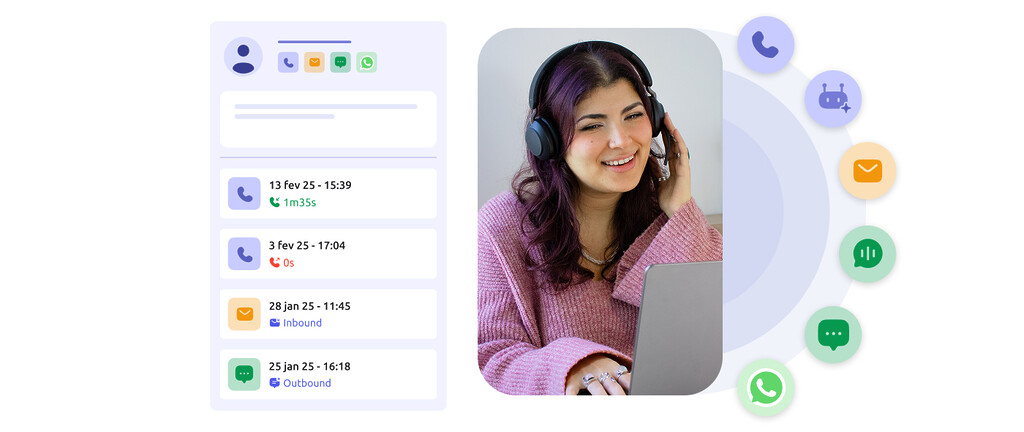
In practice, the customer service center centralizes customer requests and handles them across multiple communication channels. Phone support has historically been the primary channel, but today it is complemented by email, live chat, social media, and instant messaging.
However, the role of a customer service center no longer stops at answering incoming requests. Companies are now looking to use interaction data to better understand customer expectations and continuously improve the experience they provide. Cloud contact center platforms make it possible to coordinate conversations more smoothly and deliver a more consistent service experience.
The goals of a customer service center
Within a business, the customer service center serves several essential functions. Its first mission is to help customers use the products or services offered by the brand. Teams step in to answer questions, provide technical support, or share additional information.
In many industries, these centers also play a critical role in complaint management. When a customer runs into an issue, the quality of the response directly shapes how they perceive the company. A fast and effective resolution therefore has a major impact on satisfaction and retention. According to Salesforce, 88% of customers say good service makes them more likely to buy again from the same company.
In addition, customer service centers often support sales follow-up efforts or customer satisfaction surveys. Customer conversations then become an especially valuable source of insight. They help uncover emerging expectations, identify friction points in the customer journey, and improve the products or services being offered.
The difference between a customer service center, a call center, and a contact center
The terms call center, contact center, and customer service center are often used interchangeably. In reality, they reflect different stages in the evolution of how businesses engage with their customers.
The call center represents the traditional model. It focuses primarily on phone-based interactions, whether inbound calls for customer support or outbound calls in a sales context.
As communication methods diversified, companies gradually adopted the contact center model. This expanded interaction management by incorporating multiple channels such as email, chat, and social media.
The customer service center goes a step further. It is no longer just about managing multiple channels. It is about orchestrating all interactions through a broader customer experience strategy. Data is centralized, conversations are contextualized, and interactions become more personalized.
The communication channels used in a customer service center
Phone: still the dominant channel
Despite the rise of digital channels, the phone remains a core pillar of the customer service center. Voice interactions are particularly well suited for handling complex, urgent, or sensitive requests.
A phone conversation makes it possible to establish direct dialogue with an agent, which helps clarify situations and often speeds up issue resolution. It also preserves the human dimension of customer relationships, which is especially important during moments of frustration or dissatisfaction.
Today, cloud telephony technologies help optimize this channel. Intelligent call routing systems, real-time monitoring tools, and conversation analytics all contribute to improving both operational performance and service quality.
Digital channels: email, chat, and messaging
Alongside the phone, digital channels now play an increasingly important role in customer service centers. Email remains widely used for requests that require detailed follow-up or the delivery of information.
Live chat, meanwhile, has become a particularly effective channel for getting quick answers. It allows customers to interact with an agent while continuing to browse a website.
Instant messaging apps and social media have also become important points of contact. Many customers now prefer to use these platforms because they fit naturally into their everyday communication habits.
For businesses, the challenge is to integrate these different channels into a consistent strategy that ensures continuity of service.
Omnichannel: orchestrating channels in a unified way
As the number of channels has grown, companies initially adopted a multichannel approach. In this model, several communication methods are offered to customers, but they often operate independently.
The omnichannel approach, by contrast, aims to connect these channels in order to create a smooth and consistent experience. A customer might start a conversation in chat, continue it by phone, and then receive a follow-up by email without having to repeat the request.
To make that continuity possible, companies need to centralize interactions and customer data within a single platform. Agents then have a complete view of the interaction history, which makes it easier to personalize conversations.
The technologies used in a customer service center
Contact center platforms (CCaaS)
Modern customer service centers rely heavily on CCaaS platforms, meaning cloud-based contact center solutions.
These platforms make it possible to manage all customer interactions from a single interface. They include essential capabilities such as intelligent call routing, omnichannel conversation management, and performance monitoring tools.
Thanks to the cloud model, businesses can also adapt their infrastructure more easily to fluctuations in interaction volume and roll out new features faster.
CRMs and customer data management
CRM plays a central role in how a customer service center is organized. It makes it possible to centralize customer information, including contact details, past interactions, and purchase history.
This contextual knowledge helps agents better understand each customer’s situation and tailor their responses accordingly. As a result, interactions become more personalized and more effective.
The integration between contact center platforms and CRMs is therefore a key factor in improving the flow of conversations and connecting customer service with other teams across the business.
Artificial intelligence in customer service centers
Artificial intelligence is gradually transforming how customer service centers operate. It is now involved at multiple stages of interaction handling.
Chatbots and virtual agents, for example, can automate certain simple requests, such as order tracking or answering common questions. That allows agents to focus on more complex situations.
AI can also support agents during conversations by suggesting responses or analyzing conversation content in real time.
Finally, transcription and conversation analytics technologies make it possible to use interaction data to identify customer expectations, detect recurring issues, and improve conversation quality.
Customer service center performance metrics
Operational KPIs
Managing a customer service center relies on several operational indicators. One of the most common is average handling time, which measures how long it takes to manage an interaction.
First contact resolution is another key metric, as it evaluates the team’s ability to resolve requests during the very first exchange.
These metrics help contact center managers better understand team performance and identify areas for improvement. In a context where 86% of agents and 74% of mobile workers believe customer expectations are getting higher and higher (Salesforce), tracking these indicators becomes even more strategic for adjusting operations, training, and staffing.
Customer satisfaction metrics
In addition to operational indicators, companies also track metrics that measure customer perception.
Net Promoter Score evaluates how likely a customer is to recommend a company. Customer Satisfaction Score measures satisfaction after a specific interaction.
Customer Effort Score, in turn, evaluates how much effort customers feel they had to make to get an answer or resolve a problem. Together, these indicators provide a more complete view of the customer experience.
Interaction analysis to improve performance
Customer service centers generate a large volume of data from customer conversations.
Thanks to conversation analytics tools, this information can be used to better understand why customers are reaching out, identify recurring issues in the customer journey, or uncover opportunities for improvement.
These insights allow businesses to improve their processes while adapting their services to actual customer expectations.
How customer service centers are evolving in 2026
Artificial intelligence at the core of customer interactions
Artificial intelligence is gradually transforming customer service centers by strengthening the tools teams use every day. It helps both automate certain interactions and improve operational efficiency.
The first use cases center on self-service. Chatbots and voicebots allow customers to resolve simple requests on their own, such as tracking an order or accessing information, which reduces contact volume for agents. Forrester also predicts that one in four brands will see a 10% increase in successful simple self-service interactions by the end of 2026.
Customer service centers are also beginning to integrate agentic AI systems. These autonomous AI agents can perform certain tasks, analyze a situation, or trigger actions across different tools, making it possible to automate part of the process layer.
At the same time, transcription and conversation analytics technologies make it easier to use interaction data and automate certain quality monitoring activities. To be truly effective, these solutions increasingly rely on AI models specialized for customer service, capable of delivering both business relevance and data control within a sovereign framework.
Using data to anticipate customer needs
Customer service centers are also becoming true data analysis platforms. Every interaction generates valuable information that helps businesses better understand customer expectations.
By analyzing this data, companies can identify trends, detect weak signals, or anticipate certain needs. This approach makes it possible to build a more proactive customer relationship strategy.
Toward augmented customer service centers
The future of customer service centers depends on a balanced combination of human expertise and advanced technology. While tools are evolving quickly, customer relationships are still fundamentally built on listening and trust. Agents therefore remain essential for handling complex situations and maintaining high-quality relationships with customers.
At the same time, artificial intelligence, automation, and interaction analytics strengthen their capabilities. By automating certain tasks and extracting value from conversation data, these technologies allow teams to focus on higher-value interactions.
Augmented customer service centers therefore rely on three complementary pillars: teams, artificial intelligence, and the smart use of data. This evolution is gradually turning the customer service center into a true engine for both customer experience improvement and business performance.
Optimize your customer service center with Diabolocom