 English
 Français
 Deutsch
 Español
 Italiano
 Português
Cloud Contact Center
The customer interaction management solution built to maximize team productivity
What Is a Cloud Contact Center?
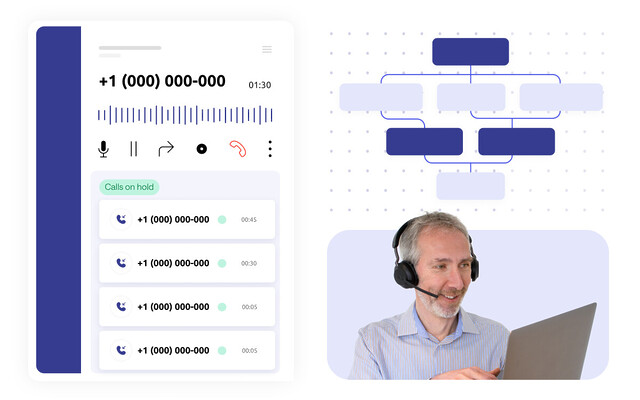
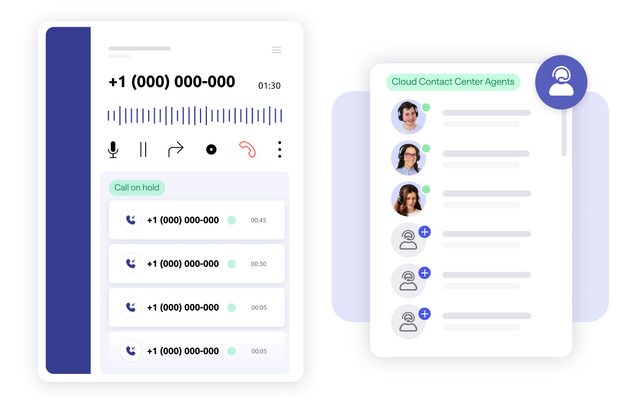
A cloud contact center is a cloud-hosted customer interaction management platform that consolidates omnichannel streams—including voice, email, SMS, and chat—into a single pane of glass. Unlike traditional on-premises call centers, this software-as-a-service solution (CCaaS) offers optimal flexibility, empowering agents to handle customer inquiries with absolute geographic freedom.
Driven by advanced Automatic Call Distribution (ACD) and artificial intelligence, the platform qualifies inquiries in real time to instantly route each customer to the most qualified available agent. This optimizes the overall customer experience while drastically reducing overhead and infrastructure costs.
What Are the Benefits of a Cloud Contact Center?
A more flexible solution to absorb peak activity
A cloud contact center delivers unprecedented agility to handle sudden spikes in call volume. Unlike legacy on-premises infrastructures, this hosted technology lets companies scale their agent seat count up or down effortlessly without heavy hardware investments. Teams can work seamlessly from home or be deployed at a moment’s notice to efficiently manage seasonal peaks. This continuous scalability guarantees that service level agreements (SLAs) are met while keeping operational costs fully under control.

A seamless customer experience across all channels
By centralizing all communication channels into a single interface, a cloud contact center breaks down data silos. Whether a customer reaches out via phone, email, live chat, or social media, their interaction history syncs automatically. Agents gain a unified, real-time view of the customer journey, enabling them to personalize conversations instantly. This omnichannel approach elevates the overall experience, eliminates customer frustration, and accelerates first-contact resolution (FCR).
Cloud Contact Center Challenges
Handling security, compliance, and data sovereignty
Adopting a cloud solution naturally raises questions about protecting sensitive information. It is critical to choose a platform that guarantees end-to-end encryption, strictly complies with major data privacy regulations (such as GDPR and CCPA), and ensures secure data hosting to prevent breaches or confidentiality violations.
Integrating the cloud contact center with existing tools
Deploying a cloud contact center shouldn’t isolate legacy systems. Interoperability is a major hurdle: the cloud contact center must integrate natively with your CRM, ERP, and core business tools via robust APIs to ensure flawless synchronization and eliminate duplicate data entry.
Core Features of a Cloud Contact Center

Intelligent routing to guide every request to the right agent
The automatic call distribution engine and skills-based routing analyze incoming requests instantly. The system then directly connects the customer to the most qualified available agent to handle their specific inquiry.
CRM integration to give agents a complete 360-degree customer view
Call distribution quality directly impacts conversion rates. Seamless CRM and phone system integration allows you to route high-intent inbound leads to the right reps based on real-time availability and expertise, closing deals faster.
Analytics and AI for continuous performance management
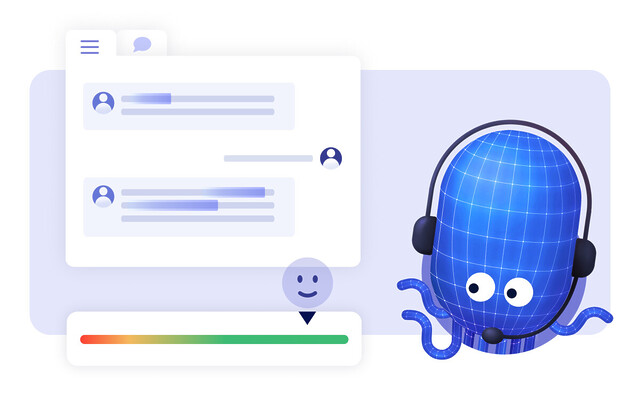
Real-time dashboards and artificial intelligence offer targeted conversation analytics. Supervisors can easily identify trends, anticipate call drivers, and adjust staffing resources to optimize service quality on the fly.
Real-time and historical metrics to drive operations
Dashboards track essential KPIs like answer rates, abandonment rates, and average handle time (AHT). They empower managers to make immediate strategic decisions and align resource allocation with shifting live call volumes.
Automated dialer with multiple outbound calling modes
The outbound dialer optimizes sales and outreach campaigns using preview, progressive, or predictive dialing modes. This flexibility eliminates idle time and maximizes agent talk time based on the contact center’s target goals.
Secure over-the-phone payments to guarantee PCI DSS compliance
This feature secures financial transactions over the phone by masking the caller’s credit card details from both the live agent and call recordings, ensuring absolute compliance with strict PCI DSS standards.
Integrating Specialized AI into the Diabolocom Cloud Contact Center
Diabolocom integrates purpose-built artificial intelligence tailored specifically for contact centers. This native system features an autonomous virtual agent, automates call summaries, analyzes customer satisfaction, and coaches live agents in real time to streamline every interaction.
FAQ
How does artificial intelligence integrate into a cloud contact center?
Artificial intelligence integrates into the core of a cloud contact center by connecting directly to data streams to analyze text and voice interactions in real time. It works upstream via Natural Language Processing (NLP) to qualify caller intent, during the interaction by providing real-time answer recommendations and contextual data to agents, and downstream by automating call transcription, intent categorization, and generating concise summaries synced directly into the CRM.
What are the benefits of a Virtual Agent integrated into a cloud contact center?
Integrating an autonomous, AI-driven Virtual Agent allows organizations to handle repetitive, standardized requests completely automatically, 24/7, without human intervention. It instantly cuts customer wait times and absorbs volume spikes via self-service. By managing simple tasks like order tracking or appointment scheduling, it clears queue backlogs, freeing human agents to focus exclusively on complex, high-value cases.
What is the difference between a cloud and an on-premises solution for a contact center?
The primary differences lie in hosting infrastructure, cost structure, and operational flexibility. An on-premises solution relies on physical servers installed locally, which demands heavy maintenance costs, complex upgrades, and locks teams to a single geographic location. Conversely, a cloud contact center (CCaaS) is hosted remotely, accessible via the internet by agents anywhere, eliminates hardware maintenance fees, and offers instant scalability to adjust user licenses based on demand.
How much does a cloud contact center solution cost?
Cloud contact center pricing depends on the required feature set and is typically structured as a monthly per-user subscription, plus telecom consumption. To review Diabolocom’s detailed pricing plans, you can access our dedicated pricing page directly.