English
 Français
 Deutsch
 Español
 Italiano
 Português

What is a sales pitch, and why does it so often fail?
A sales pitch is a structured way of communicating that helps persuade a prospect by connecting their needs to concrete, measurable benefits that fit their specific context.
On paper, that sounds simple enough. In practice, it is often poorly executed.
A message built around problem-solving
An effective sales pitch always starts by addressing the problem, never with the solution.
Prospects are not looking for technology or features. They are looking to solve a situation that is holding them back. That may be lost productivity, a declining customer experience, or a lack of visibility into performance.
As Harvard Business Review points out, customers do not buy products anymore. They “hire” companies to solve a problem. That idea fundamentally changes how a sales pitch should be built. The salesperson’s role is no longer to present a solution. It is to help the prospect clarify their need, and present how they can fulfill that need.
That shift changes the conversation entirely. It stops being about what the solution does and starts being about what it helps solve in practical terms.
Sales pitch vs. elevator pitch: what is the difference?
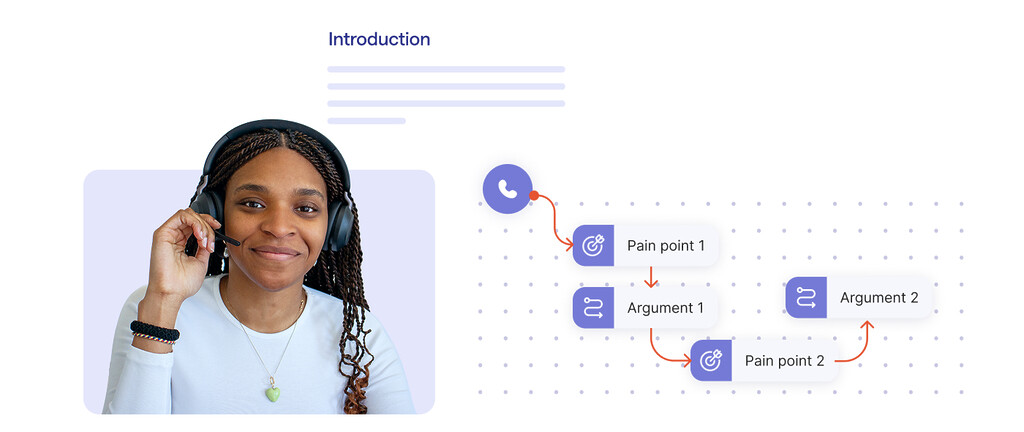
The elevator pitch is the opening move. It is short, direct, and designed to capture attention. Its purpose is to make the prospect intrigued about what the salesman has to offer.
The sales pitch comes next. It gives structure to the conversation over time. It helps explore the stakes, bring in relevant answers, and gradually build the case for a decision.
A good salesperson does not replace a sales pitch with a short pitch. They use the short pitch to open the conversation, then use the sales pitch to persuade.
What are the 3 pillars of an effective sales pitch?
A strong sales pitch rests on three complementary pillars, and all three need to be present.
As McKinsey highlights, B2B buyers increasingly want partners who can clearly demonstrate value. That shift makes it essential to build a sales pitch around concrete elements that are directly tied to the customer’s priorities.
Value
Value is what the customer gains in concrete terms. That may mean time, productivity, revenue, or better service quality. But value is not limited to upside. It also includes what the customer avoids, such as mistakes, hidden costs, or performance losses.
Proof
A short pitch is often confused with a full sales pitch.
Without proof, an argument remains theoretical. Prospects need concrete elements to feel confident. That proof can come in the form of customer stories, metrics, or real-world feedback. The closer the proof is to their own reality, the more effective it becomes.
Projection
Projection helps the prospect picture themselves using the solution. It is not enough to explain how it works. You have to show how it fits into their environment, how it would be used day to day, and what changes it would create.
Very often, that sense of projection is what turns a discussion into a decision.
The biggest mistake: talking about yourself instead of the customer
The most common mistake is relying on a standardized sales pitch. That kind of message may feel reassuring to the salesperson, but it is rarely effective for the prospect. It creates the impression of a generic conversation with little real understanding of their situation.
A high-performing sales pitch depends, by contrast, on a thorough discovery phase. That stage is what makes it possible to understand priorities, constraints, and decision criteria.
The richer that phase is, the more relevant the pitch will be.
How do you write a sales pitch that converts?
Writing a sales pitch is not about drafting a script. It is about building a flexible structure that can adapt to different stakeholders and situations.
Step | Goal | What to do |
Step 1 — Define your audience | Understand exactly who you are speaking to | Identify the real challenges, goals, constraints, and decision criteria of each stakeholder |
Step 2 — Turn features into benefits | Move from a technical message to a value-driven one | Translate each feature into a concrete business impact for the customer |
Step 3 — Structure the conversation | Adapt the sales pitch to the interaction context | Adjust your message based on the format, whether it is outreach or a meeting, and use questions to create engagement |
Step 4 — Adjust for the channel | Maximize the impact of the message | Tailor the way you communicate based on the channel being used |
Step 5 — Anticipate objections | Keep the prospect moving forward | Identify common objections and prepare thoughtful responses by understanding where they come from |
How can you continuously improve your sales pitch?
A high-performing sales pitch is never finished. Sales pitches evolve constantly based on conversations, objections encountered, and changing prospect expectations. The most effective teams do not treat their sales pitch as a fixed deliverable. They treat it as a living system shaped by what happens in the field.
Improvement is not about rewriting it from time to time, it’s about building a continuous learning loop that turns every interaction into an opportunity to improve.
Moving from a static pitch to an evolving one
In many organizations, the sales pitch is created once, and over time, it becomes outdated. Objections change, expectations shift, needs evolve, but the message stays the same.
An evolving sales pitch works the other way around. It’s built from field insights and refined continuously by analyzing constantly prospect interactions.
Building a practical improvement loop
Every sales interaction should help answer three simple questions. Which arguments sparked interest, which objections slowed the conversation down, and at what point did the prospect’s attention start to drop?
Those insights need to be captured, analyzed, and fed back into the sales pitch. That approach replaces intuition with concrete observation.
Over time, the pitch stops being based on what the company assumes is relevant and starts being shaped by what prospects actually respond to.
Using conversational data to identify what works
Sales conversations contain a wealth of information that is often underused. They reveal the words prospects use, the objections that keep coming up, the friction points, and the triggers that move the conversation forward.
Analyzing those conversations makes it possible to move beyond gut feeling. You can identify exactly which phrases work, where attention starts to fade, and which arguments trigger positive reactions. This approach is even more strategic because, according to McKinsey, data-driven sales teams that combine personalized customer experiences with generative AI are 1.7 times more likely to increase market share than those that do not.
What the data really helps you understand
Conversational data makes it possible to detect recurring patterns. For example, some objections may systematically appear at a specific stage in the sales cycle. Others may be tied to a specific customer segment.
It also helps align the message with the customer’s own language. The best sales pitches do not reuse internal marketing terms. They use the exact words prospects use themselves.
That ability to align with the customer’s language is often a major differentiator.
What role does AI play in improving a sales pitch?
Artificial intelligence makes it possible to work with this data at scale. Where human analysis quickly reaches its limits, AI can process hundreds or thousands of conversations to uncover trends.
And it does not just analyze. It also helps teams take action.
Practical AI use cases for sales pitches
AI can identify critical moments in a conversation, such as prospect hesitation or an unspoken objection. It can also suggest real-time rewording based on the context and the customer profile.
It can compare performance across sales reps and highlight the gaps. That makes it easier to spread best practices and raise the overall level of performance.
Finally, AI supports onboarding and coaching. New sales reps can rely on practical recommendations drawn from the strongest conversations.
The goal is not to standardize every message, but to strengthen each salesperson’s ability to adapt their arguments to fit the prospect’s needs.
What are the benefits of a structured sales pitch?
A structured sales pitch first and foremost brings clarity. It helps simplify topics that can sometimes be complex and makes the value of a solution immediately understandable. In a context where decision-makers are constantly being approached, that ability to get to the point often makes all the difference.
It also strengthens the credibility of the message. By relying on concrete elements and a clear logic focused on solving pain points, a sales pitch reassures the prospect and makes decision-making easier. According to Harvard Business Review, sales persuasion also depends on storytelling that clearly explains why a solution answers a real need.
Another major benefit is team alignment. When every salesperson works from a shared foundation, conversations become more consistent. The company presents a clearer, more professional image, regardless of who the prospect speaks with.
Finally, a structured sales pitch makes performance easier to manage. It becomes simpler to identify what works, adjust the message, and improve results over time. The pitch is no longer just a support tool. It becomes a real lever for continuous optimization.
How can a CCaaS platform help optimize your sales pitch in practical terms?
A sales pitch delivers its full value when it is used, analyzed, and improved continuously.
That is exactly what CCaaS solutions make possible. They help refine sales messaging, but also improve the structure of the sales process itself, including when the buyer journey begins in self-service, for example through a virtual agent.
Centralize and analyze every interaction
A CCaaS platform makes it possible to centralize all interactions, whether by phone or through digital channels.
Every interaction becomes a source of data. Teams can identify which arguments work, which objections keep coming up, and which moments matter most in conversations. This analysis is not limited to conversations with a sales rep. It also helps teams better understand the early stages of the journey, especially when a prospect looks for information on their own, interacts with a virtual agent, or submits an initial request before being routed to a rep.
As Gartner notes, “Our research reveals that 75% of B2B buyers prefer a rep-free sales experience. But digital self-service purchases are much more likely to result in purchase regret. Sales and marketing teams therefore need to identify the right balance between digital and human interactions in order to support profitable buying decisions.”
Use AI to support teams more effectively
Modern solutions include analytics and recommendation tools.
They can suggest responses in real time, help structure conversations, and improve the quality of interactions. They can also step in earlier in the sales process, for example by qualifying a request, directing a prospect to the right resource, or preparing the handoff to a sales rep after an initial self-service step. The goal is not only to improve the message, but also to make the sales journey smoother and more consistent.
Practical impact
Sales reps become more confident and more effective. They adapt their message faster and improve their performance.
Sales teams also step in more effectively, with more context about the prospect’s needs and the journey that brought them there. That makes it easier to connect self-service and human guidance without creating friction in the experience.
Align teams around the messages that work
A CCaaS platform makes it easier to scale best practices across teams.
Sales pitches stop being theoretical. They are fed by real data and updated continuously. They also become part of a broader journey-based approach, where messages, channels, and touchpoints need to stay consistent from beginning to end, whether the sales process starts with an autonomous interaction or a direct conversation with a rep.
If you’d like, I can also turn this into an even more editorial, naturally flowing version without changing the structure, so it reads less like a translated piece and more like original U.S. content.
Conclusion: toward a data-driven sales pitch
An effective sales pitch does not rely on a perfect script.
It relies on a clear understanding of what is at stake and the ability to adapt the approach.
As tools evolve and data becomes more accessible, companies can now improve their messaging continuously. A sales pitch is no longer static. It evolves with every interaction.
That ability to adapt is what now turns a simple sales conversation into a real performance lever.
As buyer expectations continue to change, companies that can turn their sales pitch into a living tool connected to field reality will gain a decisive edge. The challenge is no longer just to persuade. It is to create conversations that move the prospect forward and make them want to keep going.
Enhance commercial communications with Diabolocom