English
 Français
 Deutsch
 Español
 Italiano
 Português

What is Contact Center AI (CCAI)?
CCAI represents a major shift away from legacy automation tools that rely on rigid, static decision trees. Instead, Contact Center AI utilizes sophisticated machine learning algorithms capable of processing unstructured data streams, such as live voice or free-form text.
This technology is built on four core pillars:
- Automated Speech Recognition (ASR): Converts live customer speech into text in real time, turning voice data into an instantly actionable digital asset.
- Natural Language Understanding (NLU): Goes beyond simple keyword matching to analyze syntax, decipher the customer’s true intent, and maintain context throughout the conversation.
- Automated Customer Satisfaction Analytics: Measures interaction relevance and response alignment to evaluate the customer experience throughout the conversation, instantly flagging operational friction points.
- Generative AI (GenAI): Generates personalized responses, drafts follow-up emails, and synthesizes complex case summaries using internal company knowledge bases.
By combining these capabilities, CCAI orchestrates frictionless self-service journeys for routine inquiries while providing continuous, real-time guidance to human agents during high-stakes customer interactions.
CCaaS vs. CCAI: Key Differences
Dimension | CCaaS (Contact Center as a Service) | CCAI (Contact Center AI) |
Primary Scope | Network infrastructure, omnichannel routing, and cloud hosting. | Cognitive processing, workflow automation, and data insights. |
Core KPIs & Analytics | Volume handled, wait times, answer rates, operational AHT, technical FCR. | Customer satisfaction index, Quality Monitoring scores, script compliance, automated contact categorization. |
Core Action | Transport and route interaction streams to the right channel. | Understand intent, guide human agents, and automate responses. |
While highly complementary, CCaaS and CCAI cover distinct technical and operational scopes. Distinguishing between them is critical for building an effective technology ecosystem.
CCaaS manages accessibility and connectivity. It is the cloud platform that allows an agent to open a browser, log into their session, and receive qualified omnichannel interactions. It focuses heavily on telecom logistics and interaction history.
CCAI delivers cognitive interpretation. Without CCAI, a CCaaS platform remains a passive tool: it routes a call to a representative but cannot understand what is being said or help the agent resolve the issue faster. CCAI listens to the exchange, understands the underlying need, queries backend systems, and automates post-call workflows.
Shifting from Volume to Value: The Analytics Revolution
This fundamental difference is also reflected in the Key Performance Indicators (KPIs) and analytical dashboards generated by both systems.
- Traditional CCaaS Analytics: Focus on operational throughput, volumes, and hourly productivity. CCaaS tracks quantitative metrics like total calls handled, abandonment rate, Average Wait Time (AWT), Average Handle Time (AHT), and agent-declared First Contact Resolution (FCR).
- Advanced CCAI Analytics: Focus on quality, business value, and procedural compliance. CCAI delivers qualitative insights based on automated analysis of conversation content. It tracks customer satisfaction trends, automatically maps emerging call drivers, and objectively evaluates agent performance via automated Quality Monitoring modules (script adherence, mandatory legal disclosures, and response accuracy).
The Strategic Benefits of CCAI
Implementing a robust CCAI strategy yields measurable returns across three core axes: enterprise profitability, agent retention, and customer loyalty.
Slashing Operational Costs
The most immediate economic impact of Contact Center AI is its capacity to deflect low-value, repetitive contacts. Routine inquiries—such as order tracking, billing duplicates, or profile updates—are handled entirely via autonomous self-service. This significantly unburdens voice queues and optimizes human resource allocation.
According to McKinsey & Company, applying generative AI to customer care functions could generate productivity gains equivalent to 30% to 45% of current functional costs, primarily by improving team efficiency and reducing the volume of manually processed contacts.
Data from Gartner confirms that adopting conversational AI is a primary driver for curbing global contact center labor expenses, making it a top budgetary priority for financial leaders.
Empowering the “Augmented Agent”
Artificial intelligence is not designed to replace human teams; it is designed to liberate them from repetitive administrative overhead. By automating information lookups and CRM entry, CCAI mitigates agent burnout, allowing representatives to focus on complex problem-solving and high-value sales opportunities.
A field study conducted by Erik Brynjolfsson, Danielle Li, and Lindsey R. Raymond, published by the National Bureau of Economic Research (NBER), shows that utilizing a generative AI-based conversational assistant boosted customer support agent productivity by an average of 14%. This performance gain reached 34% for novice or lower-skilled agents, suggesting a highly potent effect on accelerating skills acquisition for new hires.
Elevating Customer Satisfaction (CSAT)
For consumers, CCAI removes the most painful friction points of customer support: long hold times and the frustration of repeating information across transfers. Information access becomes instant. When an issue requires a human touch, the agent is pre-briefed with the full interaction context, enabling immediate resolution from the very first second.
Key Capabilities of an Advanced CCAI Platform
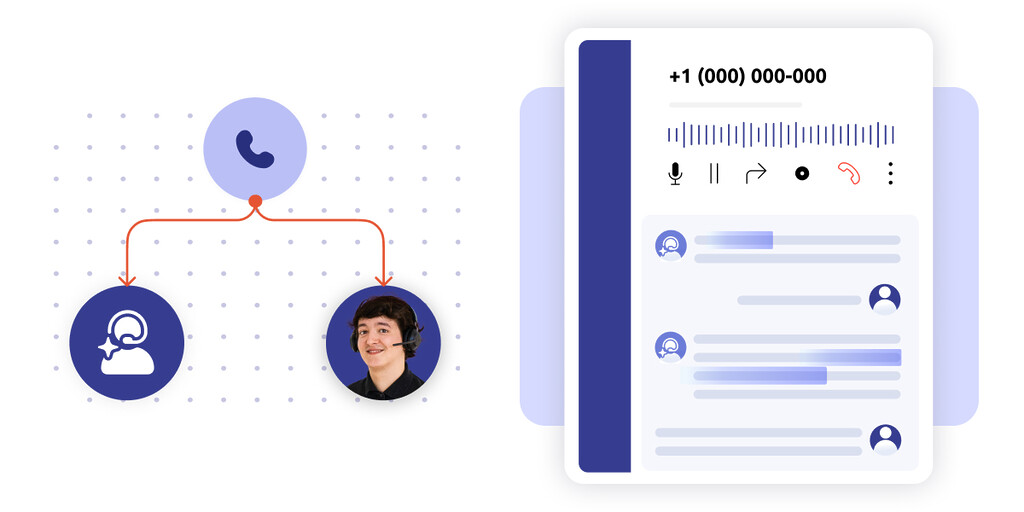 Modern Contact Center AI translates into concrete application features that fundamentally change daily operations on the contact center floor.
The Virtual Agent
The Virtual Agent serves as an intelligent, front-line point of contact. It converses with customers naturally. Unlike legacy interactive voice response (IVR) systems, it understands full sentences and automates routine workflows end-to-end. For complex cases, it executes a warm handoff to a live agent, passing along the complete conversation history.
Voice Analytics
Voice Analytics unlocks latent value buried within voice streams through deep semantic processing. It features three core capabilities:
- Real-Time Transcription: Instantly converts voice into text during the live call, fueling live analytics and in-the-moment agent guidance.
- Automated Call Summaries: Generates structured, objective post-interaction summaries immediately after a call concludes.
- Call Categorization: Labels every interaction based on the precise customer reason for contact (e.g., billing dispute, technical issue, inquiry), ensuring clean CRM data without manual agent effort.
Agent Assist (Real-Time Coaching)
While an agent is speaking or chatting with a customer, the AI listens in the background. If the customer asks a highly technical question or brings up a specific product clause, the AI pulls the relevant answer from the internal knowledge base and surfaces it on the agent’s screen. Agents no longer need to put customers on hold to scroll through documents.
Automated Quality Assurance
Traditionally, QA supervisors can only sample a tiny fraction of recorded calls to monitor performance. CCAI scales QA operations by running automated, programmatic evaluations over conversation datasets. The system flags script non-compliance, tracks mandatory regulatory verifications, and calculates customer satisfaction indexes to pinpoint exact coaching needs for managers.
Real-World Use Cases for Contact Center AI
CCAI is highly adaptable, addressing specialized operational requirements across distinct industry verticals.
Banking & Insurance: Securing Compliance and Streamlining Claims
In heavily regulated industries, CCAI acts as an automated compliance guardrail. It checks live interactions to verify that agents perform identity checks and deliver mandatory disclosure statements. During insurance claims intake, the AI parses the customer’s verbal descriptions to pre-populate claims fields in the core system and instantly validates digital supporting documents uploaded via mobile messaging apps.
E-Commerce & Retail: Taming Seasonal Interaction Spikes
During high-volume periods like Black Friday or holiday shopping seasons, contact volumes scale exponentially. CCAI steps in to autonomously resolve tier-1 support queries regarding tracking numbers, shipping status, and return policies. This allows internal teams to devote their time to personalized style consulting and high-tier dispute resolution.
Telecom & Utilities: Conversational IVR and Technical Pre-Diagnostics
CCAI upgrades standard IVR systems by replacing rigid menus with an open-ended question: “How can I help you today?” For utility or internet outages, the AI diagnoses the issue, triggers automated backend line checks via APIs, and guides the customer through basic troubleshooting steps. If a field technician dispatch is required, the live agent receives a fully documented diagnostic brief.
The Challenges of CCAI: Security, Compliance, and Sovereignty
Deploying artificial intelligence within an enterprise contact center requires navigating critical structural challenges around data architecture and corporate governance.
Data Security and Regulatory Compliance
Contact centers ingest massive quantities of highly sensitive data every day, including Personally Identifiable Information (PII), payment card data, and protected health information. Implementing CCAI means these data streams are read, transcribed, and processed by algorithms. Enterprises must guarantee that these workflows comply with global regulations, such as GDPR in Europe or the HIPAA framework for the healthcare and insurance sectors in the United States. Any data exposure or non-compliant processing introduces severe financial and legal liabilities.
The Strategic Value of Sovereignty
Data residency and processing transparency have moved to the forefront of enterprise risk management. Many legacy AI vendors rely on third-party APIs backed by servers located outside an organization’s primary legal jurisdiction. This model introduces vendor lock-in risks and compromises data control. Ensuring digital sovereignty—guaranteed containment of customer data within secure local regions, with absolute protection against public model retraining—is now a mandatory requirement for Chief Information Officers (CIOs).
The Importance of a Domain-Specific AI Model
To circumvent these challenges, some organizations attempt to patch together customer service workflows using large, general-purpose public language models. This strategy routinely fails under real-world contact center conditions.
General-purpose models introduce three fatal operational flaws:
- Latency: A customer on a live phone line or interactive chat will not tolerate a multi-second delay while a large externally hosted model generates a text stream. Frictionless CX demands sub-second response times.
- Hallucinations: Customer service tools must deliver absolute accuracy regarding pricing, policy, and contract terms. General-purpose models are prone to making up or distorting internal facts when faced with ambiguous prompts.
- Data Leakage: Routing customer records, account details, or specific transaction data through external, public endpoints compromises corporate compliance and violates data sovereignty.
True enterprise efficiency requires targeted, task-specific AI architectures.
How Diabolocom Seamlessly Unifies CCaaS and CCAI
To solve these challenges around performance, security, and operational complexity, Diabolocom takes a distinct architectural approach: we natively integrate CCAI directly into our own CCaaS infrastructure. Rather than stacking fragmented third-party software layers, we deliver a single, unified platform where communication routing and artificial intelligence are completely fused.
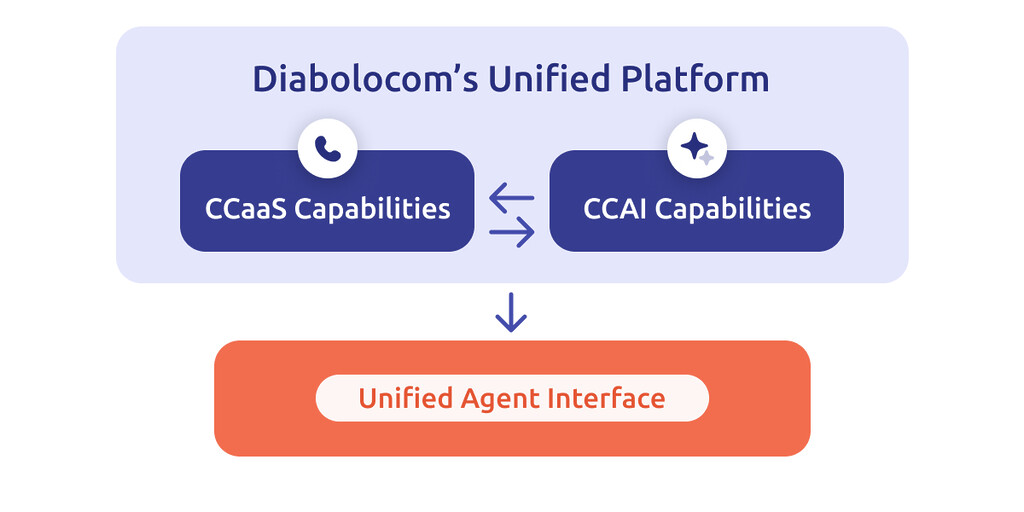
A Single, Unified Interface for Teams
Multi-window environments and software fatigue are leading causes of low agent adoption. Diabolocom eliminates this friction. Agents and supervisors manage telephony, omnichannel routing, and advanced AI capabilities within a single, centralized workspace. Agents do not need to switch applications to access live guidance or view post-call summaries; everything displays right inside their core interface, driving faster resolution times.
Deep AI Integration Across the Contact Center Lifecycle
Diabolocom injects specialized AI across every critical phase of the contact center workflow, blending infrastructure with deep cognitive insight:
- Pre-Interaction (Conversational IVR & Virtual Agent): Right at the front door, our language models identify customer intent to instantly route the customer to the optimal tier or resolve the issue autonomously via a specialized virtual agent.
- In-Interaction (Agent Assist & Voice Analytics): Driven by proprietary Automated Speech Recognition (ASR) engineered by Diabolocom Research, our voice processing is optimized specifically for legacy telecom networks (8kHz audio streams). This ensures highly accurate real-time transcription, enabling our domain-specific LLM to surface relevant knowledge base articles onto the agent’s screen instantly.
- Post-Interaction (Post-Call Automation): The AI autonomously drafts call summaries, categorizes interaction disposition codes, and pushes this structured data directly into your system of record (Salesforce, HubSpot, Microsoft Dynamics, Zendesk).
- Managerial Oversight (Quality Assurance & Analytics): Our unified dashboard merges core CCaaS traffic statistics with qualitative CCAI metrics. The platform evaluates customer satisfaction trends and monitors compliance scripts, providing managers with objective performance metrics for targeted team coaching.
Conclusion
Contact Center AI is no longer an experimental innovation; it is the definitive operational foundation for scalable, high-performance customer service. By anchoring an omnichannel CCaaS platform with domain-specific, secure artificial intelligence, organizations can strip away administrative drag, lower overhead, and unlock maximum agent capability.
As organizations navigate this transition, choosing the right technology partner is paramount. By unifying CCaaS and CCAI within a single native platform, and backing it with sovereign, highly configurable language models, Diabolocom delivers the speed, security, and accuracy required to transform your contact center into a modern engine of customer satisfaction.
Gain time and improve performance with a CCAI solution