English
 Français
 Deutsch
 Español
 Italiano
 Português
What Sustainable AI Really Means
Sustainable AI is not simply about optimizing models or reducing infrastructure costs. It is about building AI adoption that lasts. It means designing artificial intelligence systems that are embedded into everyday operations, embraced by teams, and capable of scaling with the organization over time.
In practical terms, Sustainable AI is AI that survives real-world complexity.
McKinsey’s global research on AI adoption shows that while a majority of companies report using AI in at least one business function, far fewer achieve significant enterprise-wide impact. The gap is not caused by weak algorithms but by the difficulty of integrating AI into workflows and decision-making processes.
In its report Superagency in the Workplace, McKinsey further highlights that AI creates measurable value when it enhances how people work, rather than operating as a disconnected layer of technology.
Sustainable AI, therefore, is inseparable from sustainable AI adoption.
Why AI Adoption Fails After the Pilot Phase
The lifecycle of failed AI initiatives is remarkably consistent. A pilot is launched. Early results are promising. Scaling begins. Resistance appears. Complexity increases. Adoption slows. Eventually, the initiative fades into the background.
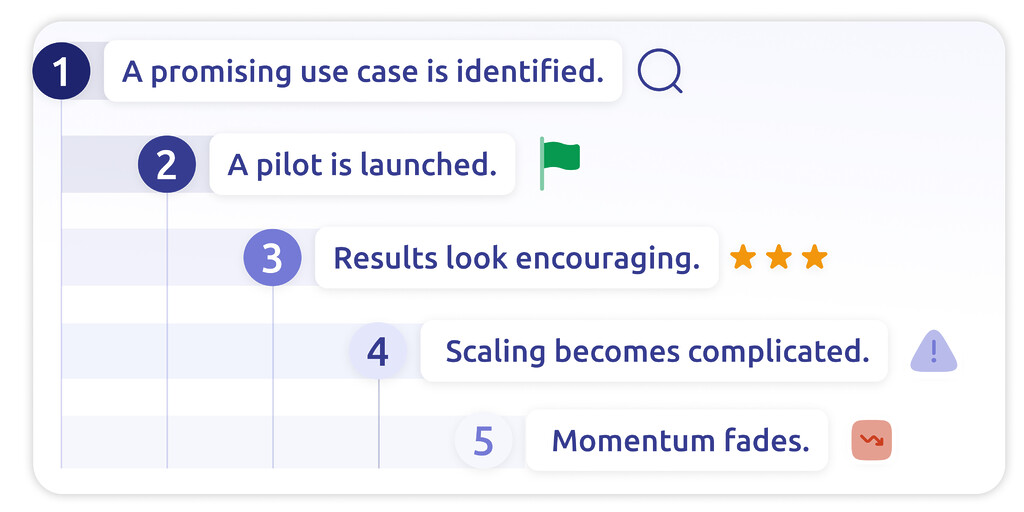
The underlying problem is rarely technical. It is organizational.
Too often, AI is layered on top of existing systems instead of integrated into them. Teams are asked to use new dashboards, consult additional interfaces, or adapt to parallel processes. Instead of simplifying work, AI complicates it. When friction increases, trust decreases. And when trust decreases, AI adoption collapses.
Boston Consulting Group confirms that while most organizations are experimenting with AI, only a minority successfully scale value across the enterprise. The limiting factors are governance, operating model redesign, and change management rather than the sophistication of the models themselves.
In Are You Generating Value from AI? The Widening Gap, BCG further explains that companies achieving impact treat AI as an organizational transformation, not a technology deployment.
Sustainable AI begins where pilot culture ends.
The Human Foundation of Sustainable AI
In contact centers, AI adoption is determined by the people who use it daily. Agents, supervisors, and operational managers ultimately decide whether AI becomes a trusted assistant or an ignored feature.
If frontline teams do not understand how AI supports their objectives, they will revert to familiar habits. If AI disrupts established workflows without clear benefits, resistance emerges. This is why AI workforce adoption must be treated as a strategic priority rather than an afterthought.
Sustainable AI is deeply human. It requires transparency, training, and clarity about how AI improves performance rather than threatens roles. Research into AI adoption barriers consistently highlights that unclear governance, low user engagement, and organizational resistance undermine implementation more frequently than technical shortcomings.
Adoption is not automatic. It is built.
The Role of Glue Employees in AI Change Management
Within every successful Sustainable AI initiative, there are individuals who act as bridges between innovation and operations. These individuals may not carry executive titles, but they play a decisive role in AI change management.
These are the Glue Employees.
Glue Employees translate strategy into practice. They test new features, share feedback, reassure skeptical colleagues, and demonstrate tangible value in everyday tasks. They create credibility around AI because they are trusted by their peers.
Without Glue Employees, AI remains an abstract initiative driven by leadership. With them, AI becomes part of the team’s operational reality.
Sustainable AI depends on these internal champions. Technology scales faster when belief spreads organically across teams.
AI in Contact Centers Must Be Embedded, Not Added
One of the main causes of weak AI adoption in contact centers is poor integration. When AI tools require agents to switch platforms, duplicate data entry, or interpret suggestions without context, efficiency decreases instead of improving.
Sustainable AI in contact centers means that artificial intelligence lives inside the existing ecosystem. Real-time suggestions appear directly within the agent interface. Automated summaries reduce after-call work without adding steps. Quality insights are integrated into supervision workflows rather than delivered through separate reporting tools.
The objective is straightforward: AI should reduce cognitive load.
Field experiments studying generative AI in professional environments show that productivity gains occur when AI is embedded into workflows rather than positioned as a standalone application.
If AI does not align with how people already work, AI adoption will remain limited.
Sustainable AI Requires a Cohesive Technology Ecosystem
While human adoption is critical, Sustainable AI also depends on technical architecture. Many organizations accumulate disconnected AI solutions over time, creating fragmented data flows and redundant systems. This patchwork approach increases complexity and undermines scalability.
Sustainable AI requires a unified ecosystem where models, data, and workflows operate coherently. It demands infrastructure that evolves with business growth and solutions that function together rather than in isolation.
BCG’s Closing the AI Impact Gap emphasizes that companies generating measurable value from AI treat it as a platform decision, not a collection of experiments.
For AI in contact centers, this means ensuring that telephony, CRM, analytics, and AI capabilities operate within a consistent environment. Scalability depends on coherence.
Feedback Loops Drive Long-Term AI Adoption
Sustainable AI is not static. It improves through iteration.
AI systems that incorporate structured feedback from agents and supervisors become more accurate, more relevant, and more trusted. Continuous monitoring, model refinement, and alignment with operational KPIs transform AI from a fixed tool into a dynamic capability.
Without feedback loops, AI stagnates. Without evolution, trust erodes. Sustainable AI adoption requires systems designed to learn from real-world usage and adapt accordingly.
Trust is the true foundation of Sustainable AI.
Sustainable AI Is a Strategic Advantage for Contact Centers
Contact centers represent one of the most human-centric operational environments in any organization. Performance depends on empathy, responsiveness, and consistency. AI can enhance these capabilities, but only if it is adopted at scale.
Sustainable AI in contact centers empowers agents rather than replacing them. It improves performance without increasing complexity. It supports operational goals while respecting human expertise.
Long-term success does not depend on deploying the most advanced AI model. It depends on achieving deep and lasting AI adoption across the workforce.
From Experimentation to Sustainable AI
Sustainable AI is not about launching more pilots. It is about designing AI adoption strategies that endure.
It requires leadership alignment, clear communication, strong AI change management, Glue Employees who drive belief, integrated workflows, scalable technology, and continuous feedback.
When these elements converge, AI stops being an initiative and becomes part of how the organization operates.
That is Sustainable AI.
Ready to Build Sustainable AI?
Sustainable AI is not about launching pilots.
It is about building AI adoption that lasts.
If you want to understand how to move from experimentation to scalable AI in contact centers, and how to drive real AI workforce adoption, download our ebook:
Discover how to implement a sustainable AI