English
 Français
 Deutsch
 Español
 Italiano
 Português

Inbound Contact Centers: The True Operational and Strategic Core
Inbound vs outbound contact center: the real operational difference
At first glance, the distinction between inbound and outbound contact centers appears straightforward: inbound handles incoming calls, outbound places calls. In reality, the difference extends much deeper. Inbound interactions are inherently unpredictable because they are driven by customer intent and urgency. A call about suspected fraud, a failed payment, or a service outage introduces pressure into the conversation from the first second, and no script can fully anticipate that dynamic. By contrast, outbound environments are usually structured around campaigns, sales initiatives, or scheduled follow-ups. They are proactive and orchestrated, whereas inbound operations are reactive and fluid, constantly absorbing sudden demand spikes, interpreting incomplete information, and delivering solutions in real time. Because of this volatility, inbound contact centers are particularly sensitive to operational inefficiencies, as routing errors, knowledge gaps, or system friction are immediately felt by customers.
Why inbound interactions are now the most strategic customer contact points
Inbound interactions often occur at pivotal moments in the customer journey, especially when expectations have not been met, confusion requires clarification, or reassurance is urgently required. These moments frequently determine whether a customer stays or leaves, whether loyalty is reinforced or quietly eroded. A billing dispute handled transparently can strengthen trust, and a fraud case resolved efficiently can create long-term advocacy. Conversely, a poorly managed escalation can undo years of brand-building efforts. For many industries, the inbound contact center is no longer a background support function but the frontline of customer experience and a decisive driver of customer lifetime value.
The Structural Pain Points Slowing Down Most Inbound Contact Centers
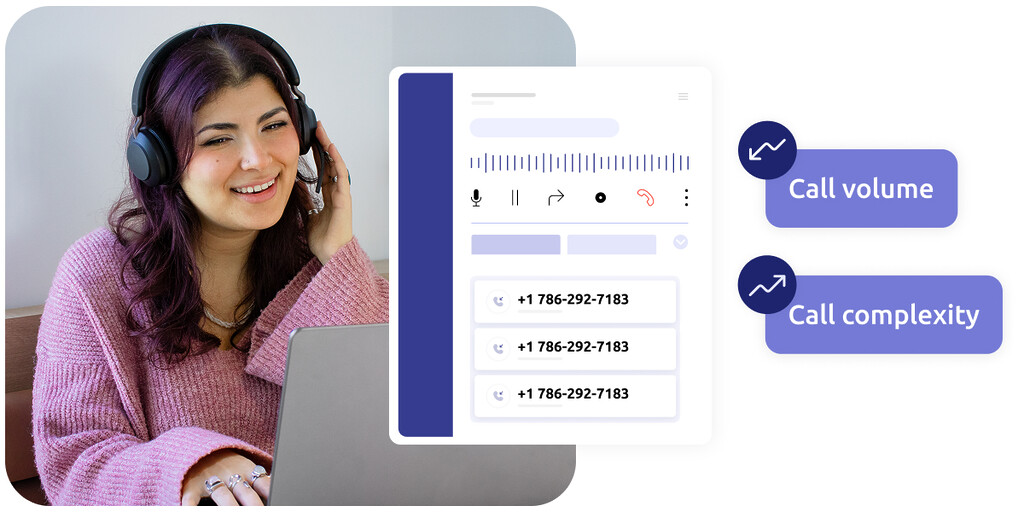
Rising complexity: fewer calls, but harder conversations
Many organizations report declining call volumes, which on the surface seems like a positive outcome driven by digital adoption and self-service expansion. Yet the situation is more nuanced. While total volume may decrease, the complexity of remaining calls increases significantly. Customers rely on chatbots, FAQs, and mobile apps for simple requests, meaning that what ultimately reaches the inbound contact center are escalation cases such as technical failures, billing disputes, fraud alerts, compliance questions, or emotionally charged complaints. Omnichannel fragmentation adds further difficulty, as customers may start on chat, move to email, and eventually call when the issue remains unresolved. Agents must then reconstruct the customer journey in real time across disconnected systems, which increases cognitive load, heightens the risk of errors, and often leads to longer silences or inconsistent responses, directly affecting customer experience and retention.
The productivity paradox: why optimizing AHT alone doesn’t solve performance issues
For decades, inbound contact center performance has revolved around average handle time, based on the assumption that shorter calls equal higher productivity. However, focusing exclusively on AHT often produces unintended consequences. When agents are pressured to end calls quickly, resolution quality can suffer, leading customers to call back, increasing repeat contact rates, and ultimately raising operational costs. The true productivity challenge lies in inefficient routing that sends customers to the wrong team, excessive time spent searching across disconnected knowledge bases, and after-call work that consumes minutes not visible in live dashboards. Manual documentation and fragmented workflows slow down operations well beyond the conversation itself. Reducing talk time does not eliminate these inefficiencies; it merely compresses them, often at the expense of resolution quality.
The visibility gap: managing performance without operational intelligence
Another structural challenge is limited real-time visibility. In many organizations, supervisors rely on retrospective reporting and sampled call reviews to evaluate performance. Without operational intelligence, emerging contact drivers are difficult to detect early, quality issues surface only after service levels deteriorate, and demand spikes catch teams unprepared. The absence of conversation analytics and live insights creates blind spots, as leaders may see average metrics but struggle to identify patterns in customer satisfaction, escalation triggers, or systemic friction points. In a high-variability environment like an inbound contact center, this visibility gap directly affects both operational performance and customer satisfaction.
How Integrated AI Transforms the Inbound Contact Center Model
AI as augmentation first, automation second
Artificial intelligence is often portrayed as a replacement technology, yet in inbound contact centers its most immediate value lies in augmentation. AI-powered agent assist tools surface relevant knowledge in real time, suggest next best actions, and flag compliance risks during live conversations, enabling agents to receive contextual guidance instead of navigating multiple systems. The productivity impact is measurable. A National Bureau of Economic Research study found that AI assistance increased issues resolved per hour by about 14%, with the strongest gains among less experienced agents. In practice, this demonstrates that AI amplifies human performance rather than replacing it. While automation remains important for repetitive and low-complexity tasks, empowering agents in high-stakes inbound environments often delivers greater strategic value than attempting to remove them from the equation.
Intelligent routing, automation, and conversation analytics
When AI is properly integrated, it reshapes the operational backbone of the inbound contact center. Intelligent routing evaluates intent, customer history, and skill requirements to connect interactions with the most qualified agent from the outset, thereby reducing transfers and accelerating resolution. Automation minimizes after-call work by generating summaries, categorizing contact reasons, and updating CRM records automatically, embedding efficiency directly into the workflow. At the same time, conversation analytics reveal recurring contact drivers, detect compliance risks, and measure sentiment trends across thousands of interactions, transforming unstructured conversations into structured insights. Predictive models enhance workforce planning by identifying patterns linked to billing cycles, product launches, or external events, allowing management to become proactive rather than reactive.
Integrated AI vs disconnected tools: why architecture matters
Not all AI deployments produce the same outcomes, particularly when organizations layer disconnected tools onto legacy systems. When AI operates separately from telephony and CRM systems, data synchronization becomes complex, latency increases, insights remain fragmented, and agents must switch between interfaces, reintroducing friction. In contrast, an integrated architecture where AI is embedded directly into the contact center platform and natively connected to CRM data creates operational coherence. Routing, analytics, automation, and agent assist operate within a unified ecosystem, reducing technical debt and ensuring that intelligence flows seamlessly across the entire inbound contact center. Over time, this architectural alignment transforms AI from a tactical addition into a structural advantage.
Designing a High-Performance Inbound Contact Center for the Next Decade

Rethinking KPIs: from average handle time to resolution quality
As inbound environments evolve, performance metrics must evolve as well. Average handle time alone cannot capture resolution quality or customer effort, which is why organizations increasingly measure first contact resolution, repeat contact rate, customer effort score, and cost per resolution. These indicators reflect what truly matters: solving the customer’s problem effectively and sustainably. When KPIs shift toward resolution quality rather than speed alone, teams naturally prioritize clarity, empathy, and long-term outcomes.
Building an adaptive operating model powered by data
A high-performance inbound contact center is not static; it continuously adapts. AI-driven insights identify emerging contact drivers and operational bottlenecks, feeding directly into process redesign, knowledge base updates, training programs, and product improvements. This creates a closed-loop system in which data informs action and action strengthens future performance. Over time, the inbound contact center becomes more than a service channel; it evolves into a source of organizational intelligence that highlights friction in billing processes, usability flaws in digital products, and gaps in communication strategies. Rather than merely reacting to problems, it helps prevent them.
The Strategic Turning Point for the Modern Inbound Contact Center
The inbound contact center has outgrown its traditional role as a reactive support function and now represents a strategic environment where complexity and urgency intersect. Rising interaction difficulty, process inefficiencies, and limited visibility have exposed the limits of legacy operating models, while integrated AI and operational intelligence offer a clear path forward. By augmenting agents, embedding intelligence into routing and workflows, and redefining performance metrics around resolution quality, organizations can transform their inbound contact center into a genuine competitive advantage. The question is no longer whether modernization is necessary, but whether the inbound contact center will remain a cost to contain or become the engine that drives loyalty, resilience, and sustainable growth.
Redefine your customer service with Diabolocom