English
 Français
 Deutsch
 Español
 Italiano
 Português

Customer care: why is it essential?
What is customer care?
Customer care encompasses all the actions that ensure interactions are tracked and that no request goes unanswered. It begins with the very first contact and continues until the issue is fully resolved. In a contact center environment, this level of oversight is critical. Interactions are high in volume and often spread across multiple channels. Without a clear structure, information gets lost and customers are forced to repeat themselves.
On the other hand, when customer care is organized effectively, agents can quickly pick up a case with the right context and move forward without starting from scratch. While customer follow-up plays a role in this process, true customer care goes further. It creates a seamless thread across every touchpoint.
Customer care as a growth driver
Over time, customer follow-up has evolved beyond an operational task. It now plays a direct role in customer retention and revenue growth. When customers feel that their concerns are tracked, deadlines are respected, and responses are consistent, the relationship becomes more stable and predictable.
That sense of reliability reduces churn and encourages long-term engagement. In addition, effective customer care limits unnecessary repeat contacts and improves team productivity.
It is therefore both a customer experience lever and a performance driver. For businesses, retention is a critical priority. According to a Harvard Business Review study, increasing customer retention by just 5 percent can boost profits by 25 to 95 percent. Strong customer care is one of the most powerful ways to achieve that impact.
Best practices for effective customer care
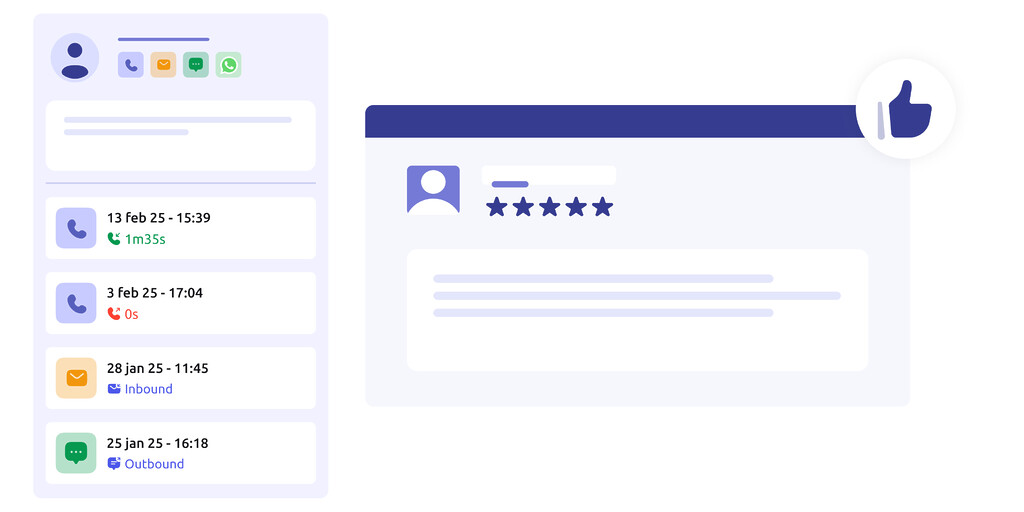
Centralizing interactions within a CRM
Reliable customer care depends on centralizing interactions. A CRM allows organizations to consolidate conversations across every channel and access a customer’s history instantly. With this unified view, agents have the information they need at their fingertips.
This prevents misunderstandings, reduces repetition, and eliminates breaks in the customer journey. In day-to-day operations, the CRM becomes the foundation of consistent customer follow-up.
Personalizing every interaction across the journey
Centralized data alone is not enough. The real value lies in how it is used. Personalizing customer care means adapting conversations based on context and previous interactions. It goes beyond scripted language. It requires understanding the customer’s real situation.
By leveraging historical data and identified needs, agents can deliver more relevant and targeted responses. This approach makes conversations feel more natural and reinforces the sense that customers are genuinely supported.
Automating key reminders and follow-ups
Automation adds significant value to customer care when implemented thoughtfully. Automated reminders and notifications ensure that planned actions are completed without relying solely on team memory.
This safeguards commitments and improves consistency. At the same time, automation frees agents to focus on more complex or sensitive issues. When used strategically, automation strengthens customer follow-up while maintaining a human-centered approach.
The benefits of high-performing customer care
Stronger retention and higher satisfaction rates
Well-managed customer care has a direct impact on satisfaction. Customers experience continuity and feel supported throughout their journey. Even when issues arise, proactive communication and clear updates help reduce frustration.
This quality of service builds trust and fosters loyalty. Customers remain confident that their concerns will be handled reliably and professionally.
Deeper customer insights to inform business strategy
Customer care also generates valuable insight into expectations and behaviors. Every interaction reveals information, whether it highlights recurring needs, friction points, or improvement opportunities.
When organizations leverage this data effectively, they can refine their commercial strategy, enhance their offerings, and better prioritize initiatives. Customer follow-up then becomes more than an operational process. It becomes a decision-making asset.
KPIs to measure customer care performance

Satisfaction and retention metrics
Evaluating customer care requires tracking satisfaction and loyalty over time. These metrics reveal how customers perceive the quality and consistency of support. When monitored regularly, they provide a clear view of the real impact of improvement efforts.
Operational efficiency metrics
Operational indicators offer additional insight. They measure responsiveness, resolution capability, and overall process fluidity. When combined with satisfaction metrics, they help contact centers refine their organization and continuously improve customer care in tangible ways.
How AI is transforming customer care into a proactive efficiency driver
Intelligent automation of tasks and reminders
Artificial intelligence enhances customer care by automating tasks with greater precision. It can trigger follow-ups at the right moment, prioritize cases, and update information without constant manual input.
This intelligent automation improves reliability and enables teams to operate more efficiently every day.
Predictive analytics to anticipate customer needs
AI also allows organizations to go further by analyzing past interactions to detect patterns. By identifying early warning signs or emerging risks, it empowers teams to act proactively rather than reactively.
Customer care is no longer limited to responding to requests. It becomes a strategic tool for anticipating needs and guiding customers more effectively over time.
Conclusion
Customer care is now a foundational pillar of modern contact centers. By ensuring continuity across interactions, leveraging the right tools, and gradually integrating AI, organizations can enhance the customer experience while increasing operational efficiency.
More than a simple process, customer follow-up is a strategic driver of retention and performance. Companies that fully embed it into their operations lay the groundwork for customer relationships that are smoother, more reliable, and built to last.
Improve CX and retention with Diabolocom